

Attention All Schools & Nurseries - September 2026 through to March 2027 we are offering 20% discount
Emergency First Aid at Work (1 Day)
The standard Emergency First Aid at Work (EFAW) course outline is a one-day, 6-hour training programme compliant with Health and Safety Executive (HSE) guidelines. It equips nominated first aiders in low-risk environments (like offices, shops, and charities) with life-saving skills to manage immediate workplace emergencies
Core Modules and Learning Outcomes
- Role and Responsibilities: Understanding legal duties, first aid kits, record-keeping, and preventing cross-infection.
- Incident Assessment: Managing safe scene approaches, dynamic risks, and calling for emergency assistance.
- The Primary Survey: Executing the DRABC protocol (Danger, Response, Airway, Breathing, Circulation).
- Unconscious Casualties: Checking for breathing, conducting secondary assessments, and placing victims in the recovery position.
- Cardiopulmonary Resuscitation (CPR): Performing adult chest compressions and rescue breaths effectively.
- Automated External Defibrillator (AED): Safe deployment, setup, and response to defibrillator voice prompts.
- Choking Management: Treating mild and severe upper airway blockages in responsive adults.
- Severe Bleeding & Wound Care: Controlling blood loss using direct pressure, packing, and bandages.
- Shock Treatment: Identifying hypovolaemic shock and executing proper patient positioning.
- Minor Injuries & Burns: Treating small cuts, bruises, splinters, scalds, and thermal burns.
- Medical Emergencies: Spotting signs of sudden illness, specifically heart attacks, seizures, and anaphylaxis.
Course Delivery Options
Skills 4 Life First Aid Training offers this course through two pathways:
- Classroom-Based: A fully hands-on, one-day practical session.
- Blended Learning: A half-day of independent online theory modules combined with a half-day of face-to-face practical training
To book a training course, visit our scheduled course section. If your course is not scheduled or you need different dates, contact our office & our admin team will be happy to assist.
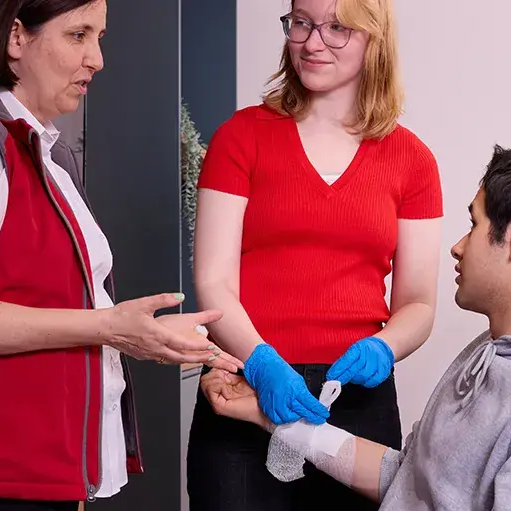
Forestry & Emergency First Aid at Work + F (Catastrophic Bleeding) (1 Day Extended)
Course Overview
The Qualsafe Level 3 Award in Forestry First Aid +F (RQF) qualification is ideal for those who work or intend to work in a forestry, agricultural or remote environment, such as tree surgeons and farmers, and outdoor expeditions, including D of E targeted expedition awards, and covers a range of injuries and diseases that could occur in these environments, such as Lyme disease and catastrophic bleeding.
Designed to accompany a regulated First Aid at Work or Emergency First Aid at Work qualification, this nationally recognised qualification has been specifically developed to meet the recommendations of the Forestry Commission First Aid at Work Policy.
Whats covered
This qualification has been specifically developed to meet the recommendations of the Forestry Commission First Aid at Work Policy.
- Roles and responsibilities of a first aider
- CPR and defibrillation
- Managing an unresponsive casualty
- Recovery Position
- Choking
- Burns and scalds
- Wounds, bleeding and shock
- Broken bones, fractures and dislocations
- Seizures and Epilepsy
- Anaphylaxis
- Asthma
- Stroke
- Heart Attack
- Minor injuries
- Extreme cold
- Extreme heat
- Treatment of Adder snake bites
- Catastrophic bleeding, including
- Direct pressure
- Tourniquets
- Hemostatic agents
- Crush injuries
- Lyme disease
Note: The content aligns with the Health and Safety Executive (HSE) syllabus.
To book a training course, visit our scheduled course section. If your course is not scheduled or you need different dates, contact our office & our admin team will be happy to assist.

First Aid at Work (FAW) (3 Day)
Our First Aid at Work (FAW) Safety Certificate is a regulated, Level 3 vocational qualification designed to comply with the Health and Safety (First Aid) Regulations 1981. It gives designated first aiders the skills to manage a wide range of workplace emergencies, injuries, and illnesses
Course Core Details
- Duration: 3 Days (18 contact hours) if completed entirely face-to-face. Blended options are available (1 day online e-learning + 2 days practical).
- Validity: The certificate is valid for 3 years. To maintain it, a 2-day Requalification course must be completed before the expiry date. The Health and Safety Executive (HSE) also strongly recommends a short, annual refresher course.
- Assessment: Candidates are evaluated through continuous practical assessments (e.g., demonstrating CPR on a mannequin) and a multiple-choice theory test.
- No formal educational prerequisites are required, though a basic command of English is necessary.
What You Will Learn
The curriculum is comprehensive, going far beyond basic life support to cover severe workplace trauma:
- Life-Saving Essentials: CPR techniques, primary/secondary casualty surveys, and full practical training with an Automated External Defibrillator (AED).
- Major Illnesses & Conditions: Identifying and responding to heart attacks, strokes, epileptic seizures, asthma attacks, diabetes emergencies, and anaphylaxis.
- Trauma & Serious Injuries: Treating head and spinal injuries, bone fractures, dislocations, chest wounds, severe burns, eye damage, and shock.
- Severe Bleeding Control: Modern courses updated in 2026 incorporate best practices for controlling catastrophic bleeding, including the use of specialized trauma dressings and tourniquets.
- Legal Responsibilities: Understanding the role of the first aider, official accident reporting procedures, and managing first aid kits.
To book a training course, visit our scheduled course section. If your course is not scheduled or you need different dates, contact our office & our admin team will be happy to assist.

First Aid at Work Re-qualification (FAW Requal 2 Day)
First Aid at Work Re-qualification (FAW Requal 2 Day)
The Qualsafe Level 3 Award in First Aid at Work (RQF) Requalification allows first aiders to renew their first aid at work qualification. During this 2-day course, candidates will practise essential first aid procedures and learn the latest techniques for dealing with emergency situations in the workplace.
As a regulated qualification, employers can book this course for their employees and rest assured that they have fulfilled their legal responsibilities for providing quality first aid training, without having to undertake any lengthy due diligence checks.
*All requalifying first aiders must have previously completed a First Aid at Work course.
Whats Covered
Topics Include
- Roles and responsibilities of a first aider
- CPR and defibrillation
- Managing an unresponsive casualty
- Recovery Position
- Choking Burns and
- scalds
- Wounds,
- Bleeding and shock
- Broken bones, fractures and dislocations
- Seizures and Epilepsy
- Anaphylaxis
- Asthma
- Stroke
- Heart Attack
- Minor injuries
Note: The First Aid at Work content aligns with the Health and Safety Executive (HSE) syllabus.
To book a training course, visit our scheduled course section. If your course is not scheduled or you need different dates, contact our office & our admin team will be happy to assist.

Emergency Paediatric First Aid (1 Day)
Course Overview
Would you know what to do if you saw a child in need of first aid?
Having a good understanding of emergency paediatric first aid is incredibly important for the safety of children and it could mean the difference between life and death.
The Qualsafe Level 3 Award in Emergency Paediatric First Aid (RQF) qualification has been designed in-line with the current Early Years Foundation Stage (EYFS) requirements and is ideal for:
• Those who have gained a level 2 or 3 childcare qualification and have entered into an early years setting and wish to be included in the staff to child ratios to comply with the EYFS requirements.
• Anyone who cares for infants and children, such as parents, guardians, grandparents. Successful candidates will be equipped with the skills needed to deal with a range of paediatric first aid situations.
Whats Covered
- Dealing with an unresponsive infant or child
- Recovery Position
- CPR and defibrillation
- Choking
- Minor Injuries
- Bites and Stings
- Seizures
- Bleeding
- shock
To book a training course, visit our scheduled course section. If your course is not scheduled or you need different dates, contact our office & our admin team will be happy to assist.

Paediatric First Aid (2 Day)
Paediatric First Aid (2 Day)
Would you know what to do if a child in your care needed first aid?
The Early Years Foundation Stage (EYFS) Statutory Framework requires all early years providers in England to have at least one person who has a current and full paediatric first aid certificate on the premises and available at all times when children are present.
Providers should also take into account the number of children, staff and layout of the premises and increase their paediatric first aid provision accordingly.
The Qualsafe Level 3 Award in Paediatric First Aid (RQF) has been specifically designed to meet the criteria set by the Department for Education’s EYFS Framework and is ideal for:
• Those who have gained a level 2 and/or level 3 childcare qualification and have entered into an early years setting and wish to be included in the staff-to-child ratios to comply with EYFS requirements.
• Registered childminders and assistants who are required to hold a current and full paediatric first aid certificate in order to comply with the EYFS. Successful candidates will learn the roles and responsibilities of the paediatric first aider, and will be equipped with the necessary skills to administer safe and effective treatment when dealing with a range of paediatric first aid situations.
To book a training course, visit our scheduled course section. If your course is not scheduled or you need different dates, contact our office & our admin team will be happy to assist.

Emergency First Aid at Work & Emergency Paediatric First Aid Combined (1 Day Extented) Joint certificate
Course Overview
This specially designed course provides the skills and knowledge needed to provide both emergency adult and paediatric first aid, perfect for schools,sports clubs or other childcare settings.
The number of training days required to achieve both qualifications has been minimised and streamlined to avoid the duplication of topics associated with attending both the Emergency First Aid at Work and Emergency Paediatric First Aid courses separately.
What’s more, this course is formed from two regulated qualifications, which employers can book for their employees and be assured that they have fulfilled their legal responsibilities for providing
quality first aid training, without having to undertake any lengthy due diligence checks.
Whats Covered
- The roles and responsibilities of an emergency first aider
- Assessing an incident
- Resuscitation
- Adult CPR and Defibrillation
- Child CPR and Defibrillation
- Infant CPR and Defibrillation
- Managing an unresponsive casualty
- Adult/Child recovery position
- Infant recovery position
- Seizures
- Adult, child and infant choking
- Wounds, bleeding and shock
- Bites and stings
- Minor injuries
- Cuts, grazes and bruises
- Minor burns and scalds
- Nosebleeds
- Splinters
To book a training course, visit our scheduled course section. If your course is not scheduled or you need different dates, contact our office & our admin team will be happy to assist.

First Aid at Work & Paediatric First Aid Combined (3 Days) Joint certificate
Course Overview
The Combined First Aid at Work and Paediatric First Aid Course is ideal for those who work in settings that require both first aiders and paediatric first aiders, such as schools, childcare settings, sports clubs or other.
Combining the Qualsafe Level 3 Award in First Aid at Work (RQF) and the Qualsafe Level 3 Award in Paediatric First Aid (RQF) into 3 extended days of classroom learning, this specially designed course minimises the number of training days required to achieve both qualifications.
Candidates will cover a range of topics needed to provide effective first aid for adults, children and infants including CPR and defibrillation, choking, stroke, head injuries, asthma and much more
Whats Covered
Topics Include:
- Roles and responsibilities of both first aiders and paediatric first aiders
- CPR and defibrillation
- Managing an unresponsive casualty
- Choking
- Burns and scalds
- Wounds, bleeding and shock
- Broken bones, fractures and dislocations
- Meningitis
- Asthma
- Seizures and Epilepsy
- Febrile convulsions
- Anaphylaxis and Allergic reaction
- Minor injuries
- Manual In-Line Stabilization Manouvre
Note: The First Aid at Work content aligns with Health and
Safety Executive (HSE) syllabus and the Paediatric First Aid
content aligns with the Early Years Foundation Stage (EYFS)
syllabus.
To book a training course, visit our scheduled course section. If your course is not scheduled or you need different dates, contact our office & our admin team will be happy to assist.

Basic Life Support with Anaphylaxis-Choking- AED Adults & Children (Half Day)
Course Overview
The Level 3 Award in BLS, AED and Management of Anaphylaxis for
Adults, Children and Infants (RQF) is designed for people who have a specific interest or responsibility at work, or in voluntary and community activities, to provide adult, child or infant basic life support (BLS), safely use a defibrillator (AED) and provide management of anaphylaxis.
The qualification and learning outcomes are based on the
recommendations of the Resuscitation Council (UK) and a distinguished panel of experts in emergency medical care.
Successful Learners will develop the practical competencies needed to
provide adult, child and infant BLS, safely use an AED and manage a
casualty with anaphylaxis.
Coures Content
- Conducting a scene survey
- Conducting a primary survey on an adult child and infant
- Identifying when to administer CPR
- Demonstrating CPR using adult, child, and infant manikins
- Demonstrating Safe use of an AED on an adult, child, and infant
- Considerations when administering CPR and using an AED
- When to place a casualty in the recovery position
- How to place an adult, child, and infant in the recovery position
- Continually monitoring breathing whilst in the recovery position
- Recognising suspected anaphylaxis
- Administering first aid for a casualty with suspected anaphylaxis
- Using an adrenaline auto-injector
To book a training course, visit our scheduled course section. If your course is not scheduled or you need different dates, contact our office & our admin team will be happy to assist.

Benedicts Law : Allergy Recognition Training
Course Overview
Benedict’s Law introduces a consistent national framework for allergy safety in schools. Core measures include:
- Whole-school allergy policies setting out how schools manage allergies and respond to emergencies
- Staff training so teachers and school staff can recognise and respond to anaphylaxis
- Access to emergency adrenaline auto-injectors (AAIs) where needed
- Individual healthcare or allergy action plans for pupils with diagnosed allergies
- Improved communication and record-keeping around allergies and allergic reactions
These measures aim to ensure that every school has the systems in place to respond quickly and effectively to allergic emergencies.
Successful Learners will develop a deeper understanding of Benedicts Law & the practical competencies needed to
provide adult, child and infant BLS, safely use an AED and manage a
casualty with anaphylaxis & asthma including correct use of inhalers, automatic adrenaline injectors and Neffy
Coures Content
- Conducting a scene survey
- Conducting a primary survey on an adult child and infant
- Identifying when to administer CPR
- Demonstrating CPR using adult, child, and infant manikins
- Demonstrating Safe use of an AED on an adult, child, and infant
- Considerations when administering CPR and using an AED
- When to place a casualty in the recovery position
- How to place an adult, child, and infant in the recovery position
- Continually monitoring breathing whilst in the recovery position
- Recognising suspected anaphylaxis
- Administering first aid for a casualty with suspected anaphylaxis
- Using an adrenaline auto-injector
To book a training course, visit our scheduled course section. If your course is not scheduled or you need different dates, contact our office & our admin team will be happy to assist.

Basic Life Support In A Clinical Setting Adults-Children-Infants This course is suitable of Doctors-Dentists-Pre Hospital Care CPD (Half Day)
Course Overview
The Level 3 Award in Basic Life Support and Management of
Anaphylaxis for Adults, Children and Infants in Clinical Practice (RQF) is intended for everyone who works in a clinical practice environment including administration and support staff. The Learner does not need to be a clinician.
The qualification and learning outcomes are based on the
recommendations of the Resuscitation Council (UK) and a distinguished panel of experts in emergency medical care.
What’s Covered?
- Conducting a scene survey
- Conducting a primary survey on an adult, child and infant
- Identifying when to administer CPR
Successful learners will attain the practical competencies needed to manage anaphylaxis and provide basic life support (BLS) interventions on adults, children and infants.
What is Covered
- Demonstrating CPR using adult, child, and infant manikins
- Demonstrating safe use of an AED on an adult, child, and infant
- Considerations when administering CPR and using an AED
- When to place a casualty in the recovery position
- How to place an adult, child and infant in the recovery position
- Continually monitoring breathing whilst in the recovery position
- Recognising suspected anaphylaxis
- Administering first aid for a casualty with suspected anaphylaxis
- Using an adrenaline auto-injector
- Demonstrating techniques for choking
- Airway Adjuncts (This will be added to the training if required)
- Oxygen (This will be added to the training if required)
To book a training course, visit our scheduled course section. If your course is not scheduled or you need different dates, contact our office & our admin team will be happy to assist.

Outdoor First Aid (2 Days)
Course Overview
Learners who complete the Level 3 Award in Outdoor First Aid
(RQF) are equipped with a broad set of skills enabling them to administer first aid in challenging outdoor surroundings which may be a few hours away from the support of the emergency services.
The course is designed for unsupported adults who run potentially high-risk activities which involve venturing out into the wilderness such as Outdoor Activity Leaders, including those participating in the Duke of Edinburgh scheme. During the 2 day course,learners will develop the skills and knowledge needed to deal with a range of outdoorfirst aid situations.
Whats Covered
- Roles and responsibilities of a first aider in an outdoor environment
- Administering first aid and managing multiple casualties outdoors
- Stabilising and insulating casualties and providing shelter
- Extremes of temperature
- Fractures, head and spinal injuries
- Drowning casualties
- Different types of burns and scalds
- Secondary survey, medical conditions
- Anaphylaxis
- Epilepsy-Seizures
- Poisoning and venomous bites
- Catastrophic bleeding
- Summoning appropriate help fromemergency or rescue services
- Manual In-Line stabilization manouvre
To book a training course, visit our scheduled course section. If your course is not scheduled or you need different dates, contact our office & our admin team will be happy to assist.

Forest School First Aid (2 Days)
Course Overview
Learners who complete the Level 3 Award in Outdoor First Aid
(RQF) are equipped with a broad set of skills enabling them to administer first aid in challenging outdoor surroundings which may be a few hours away from the support of the emergency services.
The course is designed for unsupported adults who run potentially high-risk activities which involve venturing out into the wilderness such as Outdoor Activity Leaders, including those participating in the Duke of Edinburgh scheme. During the 2 day course,learners will develop the skills and knowledge needed to deal with a range of outdoorfirst aid situations.
Whats Covered
- Roles and responsibilities of a first aider in an outdoor environment
- Administering first aid and managing multiple casualties outdoors
- Stabilising and insulating casualties and providing shelter
- Extremes of temperature
- Fractures, head and spinal injuries
- Drowning casualties
- Different types of burns and scalds
- Secondary survey, medical conditions
- Anaphylaxis
- Epilepsy-Seizures
- Poisoning and venomous bites
- Catastrophic bleeding
- Summoning appropriate help fromemergency or rescue services
- Manual In-Line stabilization manouvre
- Dealing with an unresponsive infant or child
- Recovery Position
- CPR and defibrillation
- Choking
- Minor Injuries
- Bites and Stings
- Seizures
- Bleeding
- shock
To book a training course, visit our scheduled course section. If your course is not scheduled or you need different dates, contact our office & our admin team will be happy to assist.

Epilepsy Awareness Training & Safe administration of Epilepsy Medication ( 3 Hours) This course included BLS
Course Overview
Who Is This Course For?
This qualification is ideal for anyone who has a duty of care, a specific responsibility at work, or a desire to protect their community. It is highly recommended for:
- Healthcare & Care Workers: Fulfill your professional requirements for safe medication administration and mandatory life support.
- Teachers & School Staff: Gain the specialized skills needed to manage epilepsy and pediatric emergencies in educational settings.
- Community Volunteers & General Public: Build the ultimate confidence to step in and save a life during a medical emergency.
What You Will Learn
- Epilepsy Care: Gain a deep understanding of epilepsy and learn how to safely administer buccal medications.
- Life-Saving Interventions: Master Basic Life Support (BLS) and cardiopulmonary resuscitation (CPR).
- Defibrillator Training: Learn the correct and safe use of an Automated External Defibrillator (AED).
- All Age Groups: Cover essential emergency skills for adults, children, and infants.
Certification Earned
Upon successful completion of the course, you will receive two valuable credentials:
- Certificate of Epilepsy Awareness and Safe Administration of Buccal Medications
- Accredited Level 3 Award in BLS and AED for Adults, Children and Infants (RQF)
- Regulated qualification based on the strict standards of the Resuscitation Council (UK).
Whats Covered
- What is Epilepsy
- How to recognise epilepsy
- Correct proceedure, what to do when someone is in seizure
- Safe administration of buccal medications
- Conducting a scene survey
- Conducting a primary survey on an adult,child and infant
- Identifying when to administer CPR
- Demonstrating CPR using adult, child, and infant manikins
- Demonstrating safe use of an AED on an adult, child, and infant
- Considerations when administering CPR and using an AED
- When to place a casualty in the recoveryposition
- How to place an adult, child and infant in the recovery position
- Continually monitoring breathing whilst in the recovery position
To book a training course, visit our scheduled course section. If your course is not scheduled or you need different dates, contact our office & our admin team will be happy to assist.

First Response Emergency Care Lev 3 (FREC3) (5 Days)
Course Overview
The leading Level 3 Prehospital care qualification, Qualsafe Level 3 Award in First Response Emergency Care (RQF). Equipping first responders with essential life-saving skills, exceeding HSE first aid requirements, it forms the first step of a progressive suite of prehospital care qualifications.
You will fulfil the competencies set out in the PHEM skills framework at level D, gaining the knowledge and practical skills needed to deal with a range of prehospital emergency care situations.
This qualification is the perfect fit for individuals looking to work or volunteer as a first responder. It is also suitable for emergency services, security personnel, those providing medical cover at events, and those working in high risk environments including the military, power stations, offshore, agriculture and manufacturing.
Whats Covered
- Role and responsibilities of a first responder
- Operational readiness and human factors
- Emergency services capabilities
- Structured patient assessment
Mechanism of injury and incident
- Life-threatening bleeding control
- Airway management and emergency oxygen
- Breathing difficulties (trauma and medical)
- Prehospital trauma care
- Prehospital emergency medical care
- Responding to changes in risk and/or threat
- Primary triage (Ten Second Triage) and lifesaving interventions
- Moving and handling: in an emergency and assisting a clinician
- Recording assessment findings
- Environmental exposure
- Immersion and submersion incidents
- Adult, child and infant BLS and AED usage
To book a training course, visit our scheduled course section. If your course is not scheduled or you need different dates, contact our office & our admin team will be happy to assist.

Education & Training (EAT) (5 Days)
Course Overview
The SK4L: Qualsafe Level 3 Award in Education and Training (RQF) is a regulated and nationally recognised qualification, specifically designed to be an introduction to teaching for those who work or would like to work in the further education and skills sector.
Over a 4 day period, candidates will build an understanding of the specific roles and responsibilities related to planning, delivering
and reviewing inclusive training sessions.
Topics covered include: maintaining a safe and supportive learning environment, ways to create an inclusive teaching and learning environment, assessing learners and providing constructive and developmental feedback.
Successful candidates will be prepared to teach in a wide range of contexts, in environments such as Further Education (FE) Colleges, Local Authorities or independent training.
Whats Covered
- Roles and responsibilities in education and training
- Ways to maintain a safe and supportive learning environment
- Relationships between teachers and other professionals
- Boundaries between the teaching role and other professionals
- Points of referral to meet the individual needs of learners
- Different methods of assessment and how they can be adapted to meet individual learner needs
- How to involve learners and others in the assessment process
- The role and use of constructive feedback
- Record keeping of assessment
To book a training course, visit our scheduled course section. If your course is not scheduled or you need different dates, contact our office & our admin team will be happy to assist.

School Workshops (Basic Life Support) (2 Hours)
The SK4L Certificate in BLS and AED for Adults, Children and Infants
is designed for people who have a specific interest or responsibility at work, or in voluntary and community activities, or children attending senior school to provide basic life support (BLS) and safe use of a defibrillator (AED) on adults, children and infants.
The certificate and learning outcomes are based on the recommendations of the Resuscitation Council (UK) and a distinguished panel of experts in emergency medical care.
Successful Learners will develop the practical competencies needed to
provide BLS interventions (including the use of an AED) on adults, children and infants.
If the students attending this course are 14 year+ they can, upon completion of the 3 hour course, receive a fully accredited certificate. This must be requested at the time of booking.
Whats Covered
- Conducting a scene survey
- Conducting a primary survey on an adult, child and infant
- Identifying when to administer CPR
- Demonstrating CPR using adult, child, and infant manikins
- Demonstrating safe use of an AED on an adult, child, and infant
- Considerations when administering CPR and using an AED
- When to place a casualty in the recovery position
- How to place an adult, child and infant in the recovery position
- Continually monitoring breathing whilst in the recovery position
To book a training course, visit our scheduled course section. If your course is not scheduled or you need different dates, contact our office & our admin team will be happy to assist.

School Workshops Bespoke ( Half or Full Day)
Please contact our office to discuss your details.
01484 532 500
To book a training course, visit our scheduled course section. If your course is not scheduled or you need different dates, contact our office & our admin team will be happy to assist.

First Aid For Taxi Drivers, Driving Instructors & New Drivers (1 Day)
The standard Emergency First Aid at Work (EFAW) For Taxi Drivers & New Drivers course outline is a one-day, 6-hour training programme compliant with Health and Safety Executive (HSE) guidelines. It equips nominated first aiders in low-risk environments (like offices, shops, and charities) with life-saving skills to manage immediate workplace emergencies
Core Modules and Learning Outcomes
- Role and Responsibilities: Understanding legal duties, first aid kits, record-keeping, and preventing cross-infection.
- Incident Assessment: Managing safe scene approaches, dynamic risks, and calling for emergency assistance.
- The Primary Survey: Executing the DRABC protocol (Danger, Response, Airway, Breathing, Circulation).
- Unconscious Casualties: Checking for breathing, conducting secondary assessments, and placing victims in the recovery position.
- Cardiopulmonary Resuscitation (CPR): Performing adult chest compressions and rescue breaths effectively.
- Automated External Defibrillator (AED): Safe deployment, setup, and response to defibrillator voice prompts.
- Choking Management: Treating mild and severe upper airway blockages in responsive adults.
- Severe Bleeding & Wound Care: Controlling blood loss using direct pressure, packing, and bandages.
- Shock Treatment: Identifying hypovolaemic shock and executing proper patient positioning.
- Minor Injuries & Burns: Treating small cuts, bruises, splinters, scalds, and thermal burns.
- Medical Emergencies: Spotting signs of sudden illness, specifically heart attacks, seizures, and anaphylaxis.
Course Delivery Options
Skills 4 Life First Aid Training offers this course through two pathways:
- Classroom-Based: A fully hands-on, one-day practical session.
- Blended Learning: A half-day of independent online theory modules combined with a half-day of face-to-face practical training
To book a training course, visit our scheduled course section. If your course is not scheduled or you need different dates, contact our office & our admin team will be happy to assist.

Emergency Response Ambulance Driving (CERAD) (120-160 GLH)
Course Overview
The Qualsafe Level 3 Certificate in Emergency Response Ambulance Driving (RQF) (CERAD) qualification has been designed to meet high speed driver training regulations and allows ambulance service
drivers to claim exemptions under the Road Traffic Act.
The CERAD qualification can be delivered in the following emergency response vehicle categories:
Class 2 Category B Solo Response Vehicle
Class 2 Category B Motor Ambulance: 3250kg-3500kg
Class 3 Category C1 Motor Ambulance: weight exceeding 3500kg
Successful candidates will have the knowledgeand skills to drive an ambulance routinely and respond to incidents in a range of
environments under emergency and non-emergency conditions.
Whats Covered
- Legislation, regulations, policies and procedures relevant to advanced driving
- In-depth knowledge of traffic signs, markings and furniture
- How human physiological, psychological and situational factors affect driver behaviour
- Responding to confrontational and non confrontational driver behaviour
- Manoeuvring a service vehicle in a safe and professional manner under non-emergency and emergency response conditions
- Applying the system of car control
- Driving safely and arriving at an incident on a multilane carriageway
- Navigating to a given destination verbally and using satellite navigation
- Understanding what is involved when carrying out a collision investigation
- Implementing and formulating effective driving plans
- Knowing how to carry out incidental convoy driving
- Driving under emergency and non-emergency conditions in the hours of darkness
To book a training course, visit our scheduled course section. If your course is not scheduled or you need different dates, contact our office & our admin team will be happy to assist.

Mini Medics First Aid (School Workshop) (6 x 1 hour set sessions)
Course Overview
The Mini Medics Workshop introduces children to the importance of first aid and defibrillation. It strips away complex medical jargon, keeping things simple, memorable, and entirely hands-on. Using specialised child-friendly manikins and trainers, children develop life-saving habits and the confidence to help in emergencies.
Workshop Content & Modules
Module 1: The First Aid Hero (30 mins)
- What is First Aid? Simple definition of what a first aider does.
- Staying Safe: Checking for danger before helping someone else.
- Calling for Help: How to contact emergency services (999/112) and what information to give.
- The First Aid Kit: Exploring what is inside a standard kit and how to use the items safely.
Module 2: Helping an Unconscious Person (45 mins)
- The Shake and Shout: How to check if someone is awake or asleep.
- The Recovery Position: Step-by-step practical practice rolling a friend into a safe sleeping position.
- Checking for Breathing: Look, listen, and feel for normal breathing.
Module 3: Heartstart & AED Basics (45 mins)
- Chest Compressions (CPR): Rhythmic practice to fun, upbeat songs (like "Staying Alive") on child manikins.
- What is an AED?: Demystifying the Automated External Defibrillator.
- Using an AED: Live demonstration showing that the machine safely speaks and tells you exactly what to do.
Module 4: Everyday Knocks and Bumps (45 mins)
- Asthma: Recognising an asthma attack and how to assist a friend with an inhaler.
- Choking: What to do when someone cannot breathe or cough.
- Wounds and Bleeding: How to apply pressure and dress basic cuts and grazes.
- Shock: Simple steps to comfort someone who is scared or hurt.
Module 5: Wrap-up & Graduation (15 mins)
- Q&A Session: Giving children a chance to clarify any questions.
- Mini Medic Pledge: A fun promise to always seek adult help in an emergency.
- Presentation Ceremony: Handing out certificates and student packs.
Educational Value & Delivery Style
- No Fear Approach: Topics like blood and serious injury are handled gently to ensure no child leaves feeling anxious.
- Highly Practical: Every child gets physical practice time with manikins, training AEDs, and real bandages.
- Curriculum Alignment: Directly maps to the UK National Curriculum for PSHE (Physical Health and First Aid requirements for primary schools).
What Each Child Receives
- Official Mini Medics Certificate of attendance.
- Fully illustrated, child-friendly booklet to take home and share with parents.
- Mini Medics syringe pen or pencil pack (optional booking add-on).
To book a training course, visit our scheduled course section. If your course is not scheduled or you need different dates, contact our office & our admin team will be happy to assist.

Bespoke Training: Contact for details
Please contact our office.
01484 532 500
Request a Bespoke Training Quote
Please provide the following information, and our training compliance team will design a tailored course that perfectly matches your team’s needs, schedule, and environment.
1. Contact & Organisation Details
- Organisation Name:
- Contact Name & Job Title:
- Email Address & Direct Phone Number:
- Industry Sector: (e.g., Primary School, Construction, Care Home, Corporate Office)
2. Core Training Requirements
- Which core topics do you need to cover?
- Epilepsy Awareness & Buccal Medication
- Basic Life Support (BLS) & CPR
- Automated External Defibrillator (AED) Training
- Paediatric First Aid (Infants & Children)
- 'Mini Medics' Children’s Workshop
- Other Specialist Topics: [Free text]
- Is this course for compliance, regulation, or general awareness? (e.g., Ofsted, HSE, Care Quality Commission compliance, or simply peace of mind)
3. Learner Demographics
- Target Audience: Who will be attending this training? (e.g., teachers, teaching assistants, support workers, lunchtime staff, nurses)
- Estimated Number of Learners:
- Prior Experience: Are the candidates complete beginners, or is this a refresher course for experienced staff?
4. Logistics & Delivery Preferences
- Preferred Delivery Method:
- On-site (Our trainers come to your school/venue)
- Off-site (Held at our dedicated training center)
- Blended Learning (Part online theory, part face-to-face practical)
- Preferred Dates & Times: (e.g., Specific dates, standard working hours, evening twilight sessions, weekend slots)
- Course Duration Constraints: Do you have a strict timeframe? (e.g., Must fit into a 2-hour inset slot, half-day, or full-day)
5. Unique Workplace Risks & Needs
- Specific Medical Case Studies: Are there specific individuals in your care with unique medical needs we should focus on? (e.g., A specific child with complex epilepsy triggers)
- Additional Comments or Special Requests:
To book a training course, visit our scheduled course section. If your course is not scheduled or you need different dates, contact our office & our admin team will be happy to assist.

Mental Health First Aid
Our Mental Health First Aid (MHFA) Level 3 Award is a regulated, comprehensive 2-day training qualification (typically 12 to 14 guided learning hours). It is specifically designed to equip managers, supervisors, HR professionals, and designated workplace first aiders with the advanced skills needed to spot signs of mental ill-health, initiate supportive conversations, and manage crisis situations safely.
The standard course syllabus covers several core modules, outlined below:
1. Understanding Mental Health and Well-being
- Definitions: Distinguishing between mental health, poor mental health, and diagnosed mental ill-health.
- Stigma and Culture: How to challenge negative attitudes and promote a positive, inclusive workplace culture.
- Risk Factors: Identifying biological, psychological, and social factors that can predispose individuals to mental health struggles.
- Resilience: Understanding how components of mental well-being protect against workplace stress.
2. Roles, Responsibilities, and Legislation
- First Aider Boundaries: Clarifying the role of an MHFAider as a supportive signposter rather than a therapist or diagnostician.
- Legal Frameworks: Understanding employer compliance, including the Health and Safety (First Aid) Regulations and relevant equality laws.
- Self-Care: Managing your own boundaries, emotional triggers, and psychological well-being while supporting others.
3. Identifying and Understanding Mental Health Conditions
This module dives deeply into the characteristics, signs, symptoms, and impacts of major conditions:
- Stress and Anxiety: Recognizing generalized anxiety, panic attacks, phobias, OCD, and work-related stress.
- Mood Disorders: Spotting the signs of Depression and Bipolar Disorder.
- Trauma-Related Stress: Recognizing the impacts of Post-Traumatic Stress Disorder (PTSD).
- Psychosis: Understanding conditions like Schizophrenia and psychotic episodes.
- Eating and Personality Disorders: Basic signs, behavioral indicators, and manifestations.
- Substance Misuse: Understanding the intersection of alcohol, drug abuse, and mental health issues.
4. The Mental Health First Aid Action Plan
- Starting the Conversation: Learning non-judgmental, empathetic active listening techniques.
- Crisis Intervention: De-escalating urgent situations involving self-harm or suicidal ideation.
- The Action Plan Protocol: Implementing structured assessment tools (such as the ALGEE or DR EFG framework) to safely navigate an intervention.
5. Signposting, Referrals, and Recovery
- Support Networks: Identifying internal resources (like Employee Assistance Programmes) and external pathways (like local charities, NHS, or crisis lines).
- Workplace Integration: Assisting individuals who are returning to work or taking time off due to poor mental health.
Course Delivery and Assessment Overview
- Duration: Minimum 12–14 contact hours split over 2 consecutive days (or up to 6 weeks part-time).
- Assessment: A written/multiple-choice exam (or workbook assessment) alongside continuous practical assessments by the trainer.
- Certification: Regulated Level 3 Award (RQF) that remains valid for 3 years.
Note: Our unregulated course follows the identical course structure and lesson plan, meeting all Ofsted and HSE requirements. Contact us for further information.
To book a training course, visit our scheduled course section. If your course is not scheduled or you need different dates, contact our office & our admin team will be happy to assist.

Mental Health First Aid (1 day)
A 1-day Mental Health First Aid (MHFA) course—often certifying you as an MHFA Champion or Level 2 First Aid for Mental Health—is a 6-hour program. It teaches you to spot signs of mental ill health, start supportive conversations, use the ALGEE action plan, and guide people to professional help.
Course Overview & Format
- Duration: Typically 1 day (6 to 6.5 hours, e.g., 09:00 to 16:30).
- Delivery: Available face-to-face or via online virtual interactive sessions.
- Materials: Usually includes a workbook, certificate of attendance or qualification, and a reference card for action plans.
Core Curriculum
- Understanding Basics: Introduction to mental health, stress, and reducing stigma.
- Common Conditions: Spotting early signs of depression, anxiety, eating disorders, or psychosis.
- The ALGEE Action Plan: Learning how to Approach, Listen, Give support, Encourage professional help, and Encourage other supports.
- Crisis Support: Basic handling of panic attacks, self-harm, or suicide risk.
To book a training course, visit our scheduled course section. If your course is not scheduled or you need different dates, contact our office & our admin team will be happy to assist.

Blended Learning
Blended Learning is the best of both worlds, combining our high
quality classroom teaching with immersive e-Learning.
Gain an in-depth understanding of theory at your own pace with our fantastic e-Learning packages, before joining a classroom
based section to cover vital practical skills and complete your assessment.
You can rest assured that you’re gaining the highest quality training, whether in the classroom or from the comfort of your own home – our Qualsafe Awards qualifications are all Ofqual regulated.
SK4L offer Blended Learning in:
Emergency First Aid at Work (EFAW) E-Learning & 1/2 day practical face to face
First Aid at Work (FAW 3 day) E-Learning & 2 days face to face practical training
First Aid at Work Requalification (FAWrq) E-Learning & 1 day face to face practical training
Paediatric First Aid (PFA) E- Learning & 1 day face to face practical training.
To book a training course, visit our scheduled course section. If your course is not scheduled or you need different dates or blended learning, contact our office & our admin team will be happy to assist.

Not sure how many first aiders you require. We can help. Try our first aid calculator.
